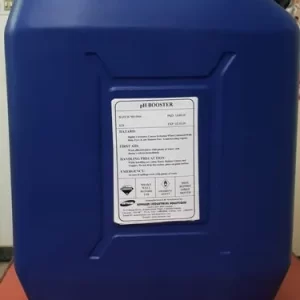
RO SILICA ANTISCALANT ( ENVKEM-5030)
ENVKEM 5020 – SILICA ANTI SCALANT
Reverse Osmosis (RO) Membrane performance can be negatively impacted by impurities that build up on the membrane surface during operations. Suspended solids, microorganisms and mineral scale can foul membrane elements. These deposits can cause loss in output and/or rejection levels and reduce total system performance.
ENVKEM 5020 – ANTISCALANT SPECIFICATION:
| PH (as such) | < 3.5 |
| Appearance | Pale Yellow Liquid |
| Water Solubility | Completely Soluble |
| Solid Content | 33% to 34% w/w |
| Specific Gravity | 1.17 to 1.23 |
Antiscalants are surface active materials that interfere with precipitation reactions in three primary ways:
- Threshold Inhibition: It is the ability of an antiscalant to keep supersaturated solutions of sparingly soluble salts.
- Crystal Modification: It is the property of an antiscalant to distort crystal shapes, resulting in soft non adherent scale. As a crystal begin to form at the submicroscopic level, negative groups located on the antiscalant molecule attack the positive charges on scale nuclei interrupting the electronic balance necessary to propagate the crystal growth. When treated with crystal modifiers, scale crystals appear distorted, generally more oval in shape, and less compact.
- Dispersion: Dispersancy is the ability of some antiscalants to adsorb on crystals or colloidal particles and impart a high anionic charge, which tends to keep the crystals separated. The high anionic charge also separates particles from fixed anionic charges present on the membrane surface.
ENVKEM 5020 is designed to eliminate scale and reduce fouling in membrane systems, regardless of the feed water source.
Benefits:
- » Restores and prolongs membrane life
- » Maintains system performance
- » Reduces down time
- » Protects membranes from oxidizing agents
Description:
(Super Antiscalant) OTHERS
(Conventional Antiscalant) 1) High specific gravity ,Low viscosity
(Solid contents /Active Ingredients @39%)
1) Low specific gravity ,High viscosity
(Solid contents /Active Ingredients @15-20%) 2) C.V> 600
(Phospoines/Amines,Ter /Co-Polymer) 2) C.V> 400-500
(HEDP /ATMP/Homo /Co-Polymer) 3) Higher LSI +3.2 3) Lower LSI +2.5 4) Triple filtered 4) Single / Doubled filtered 5) Double DI Water as product solvent 5) DM /RO Water as product solvent 6) Light yellow to Brown ,slight Odour 6) Colour ,Smells
7) Most economical average price
7) Costlier average price @Rs.350/- 8) RejectControl Parameters
i) Silica limit = 300-325 +ppm
ii) Sulphate limit =3500 -6500 ppm
iii) Iron limit = 1.5-4.0 ppm 8) RejectControl Parameters
i) Silica limit = 200-250 max ppm
ii) Sulphate limit =2500 -3500 ppm
iii) Iron limit = 1.5-3.0 ppm Comparison Chart Between Super Antiscalant and Other Antiscalant
Abstract: After using ENVKEM Antiscalant permeate ratio exceeded, permeate TDS /conductivity lowered, pressure differential lowered, Membrane Cleaning frequency extended and ensures longer Membrane Life of 3-5 years.
SOFTWARE SUPPORT SYSTEM
- Based on water chemistry Pressure :- 50-100
- Based on operation Recovery :- 1-75%
- Based on design Running hour :- 0-24 hr
DOSING PATTERN OF ANTISCALANT ( ENVKEM 5020/30 )
TDS
(Feed)
Conductivity
(Feed)
Total Hardness
(Feed)
Total Alkalinity
(Feed)
Chloride
(feed)
Ph
(Feed)
SDI
(NTU)
(Feed) Feed
Water
Temp
(ºC)
Silica
Reactive
(Reject)
Iron
(FeO2)
(Reject)
Fluoride
(Calcium)
(Reject)
Calcium
Sulphate
(Reject)
Strontium
Sulphate
(Reject)
Barium Sulphate
(Reject) Dosing
Pattern
In ppm
100-1000
135-1350
1-50
1-50
1-50
4.0-6.5
1.0-2.0
5-15
1-50
0.1-0.5
1-5
1.0-500
10-25
0.1-0.2
2.0 -3.0
1000-3000
1350-40500
50-300
50-200
50-300
6.5-7.2
2.0-3.0
15-22
50-100
0.5-1.0
5-10
500-1000
25-50
0.3-0.5
3.0 – 5.0
3000-6000
4050-6750
300-500
200-300
200-300
7.2-7.5
3.0-5.0
22-27
100-200
1.0-1.5
10-20
1000-1500
50-100
0.5-1.0
6.0 – 10.0
6000 -10000
6750 -10800
500-700
300-500
300-500
7.5-8.0
5.0-5.5
27-30
200-275 1.5-2.0/
515-
1grade 20-35/
516-
1grade 1500-2000/
516-
1grade 100-125/
516-
1grade
1.0-1.5
10.0 – 12.0
10000-15000
10800-16200
700-900
500-600
500-600
8.0-9.0
5.5-6.0
30-35
275-350
2.0-2.5
35-45
2000-3000
125-150 1.5-2.0/
516-
1grade
12.0 – 15.0
Input Output
NOTE: – Working LSI with ENVKEM 5020 +2.6
In General 6-10ppm in Feed is a optimum Dosage.
ATTENTION ALL RO OEM’S / END USERS
WHY ENVKEM ANTISCALANT?
(FOR A LONGER MEMBRANE LIFE)
- The Best ingredients Phosphino , Amines & multi-Polymer or amino phosphate.
- Higher specific gravity due to higher active ingredients /solid content @ 23-45%
- Highest ever chelation value (c.v)of Antiscalant is >600 c.v while market trend is merely 400-500 c.v
Antiscalant.
- Triple filtration process applied during manufacturing process in place of single or double filtration.
- Using double deionised water as product solvent in place of DM Water.
- Use only higher chelation & distortion value Antiscalant (ENVKEM 5020) for higher permeate recovery percentage ,lower permeate conductivity,optimized pressure differential ,extended cleaning frequency & a longer membrane life of 3-5 years.
- After using ENVKEM additive soda ash consumption minimize or even eliminate that has a major drawback in terms of major cost addition, TDS addition and sludge handling cost.
Antiscalant quality confirmation procedure by following comparative jar test:-
- Take 2 ltr brine water sample containing high hardness, high silica, high iron, high sulphates and high fluorides
- Test all water parameters i.e.hardness, silica, iron, sulphates, fluoride etc of above water.
- Divide this 2 ltr brine water in 1 ltr each jar.
- Add and stir 5-9mg/ltr of each Antiscalant in two separate jars i.e.microchem vs any other Antisacalant.
- After addition and proper stirring further test all water parameters and observe chelation or salt reduction of each Antiscalant and see major difference.